
Instant funding eliminates the evaluation phase entirely. You pay an upfront purchase fee, receive active account credentials, and begin trading under funded-account rules from day one. There is no preliminary profit target to clear, no two-stage verification challenge, and no artificial calendar clock forcing you to trade when market conditions are poor.
The marketing appeal is undeniable. For many traders, navigating restrictive evaluation rules and monthly subscription rebills feels like an exhausting psychological ordeal. But proprietary trading firms manage real risk. When a firm removes the qualification gauntlet, it does not stop managing risk; it simply shifts the filter from before you get the account to after you start trading it.
Every instant funding model recovers the risk of unscreened traders through specific structural mechanisms: higher upfront entry prices, tighter trailing drawdowns, mandatory safety reserve buffers, and strict payout gates. This guide breaks down how instant funding actually works in futures trading, compares verified direct-funding programs, and reveals whether skipping the evaluation is mathematically worth it for your strategy.
If you prefer structured qualification programs, explore our one step evaluation hub and two step evaluation hub, or browse all head-to-head comparisons on our comparisons hub.
What Instant Funding Actually Is
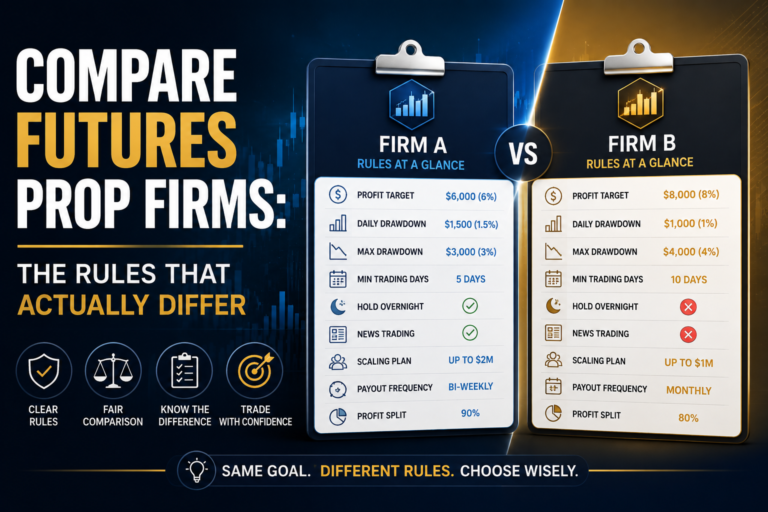
In standard futures prop trading, you purchase an evaluation challenge. You must generate a designated profit target (usually 6% to 10%) while keeping losses above a maximum drawdown floor. Once you hit the target and satisfy minimum trading days, you submit identity verification, pay an activation fee, and convert to a funded or simulated funded account.
With instant funding, that entire front-end barrier is removed. Your purchase immediately opens an active account governed by live payout conditions. You trade immediately, and any profit you generate above the required safety buffer becomes eligible for cash withdrawals.
The practical difference is where your risk sits:
- On an evaluated account: Your risk is front-loaded. You pay a low fee (\$30 to \$100) and take calculated risks to hit a target. Once funded, the rules often become more forgiving, and drawdowns may lock permanently at your starting balance.
- On an instant funding account: Your risk is entirely back-loaded. You start with zero cushion above your failure floor. A single undisciplined morning can wipe out a \$300 to \$800 purchase immediately, with no cheap reset available.
If you are new to futures prop terminology, Chapter 04 explains how futures prop trading works from the beginning.
Instant Funding Programs Compared: Verified Futures Firms
Direct funding structures vary substantially between firms. The table below compares the verified instant funding and direct-funded alternatives reviewed across our directory.
| Firm & Plan | Account Sizes | Drawdown Mechanism | Daily Loss Limit | Starting Profit Split | First Payout Gate | Full Review |
|---|---|---|---|---|---|---|
| Tradeify Lightning | 50K, 100K, 150K | Trailing Drawdown | Soft breach (pauses day) | 90 percent | 10 active days, 20% consistency rule | Read review |
| Blueberry Futures Direct | 25K, 50K, 100K | End of Day Trailing | Yes (Hard breach) | 80 percent (rises to 90%) | Minimum 14 trading days, profit buffer | Read review |
| Alpha Futures Advanced | 50K, 100K, 150K | End of Day (Locks at starting balance) | None during session | Flat 90 percent | 5 Winning Days ($200+) for 50%, 30 for 100% | Read review |
| Bulenox Option 1 & 2 | 25K, 50K, 100K, 250K | Choice: Intraday trailing or EOD | None (Total trailing only) | 100% first $10,000, then 90% | Safety reserve buffer required | Read review |
| Elite Trader Funding Static | 100K, 150K, 250K | Static Drawdown (Never trails) | None | 100% first $12,500, then 90% | 15 minimum trading days, consistency rule | Read review |
| AquaFutures Instant | 50K, 100K | End of Day Trailing | Soft pause limit | 90 percent | Fee refunded on 4th successful payout | Read review |
Every firm we review is catalogued on our futures prop firms directory, and our scoring method is detailed on how we score and rank firms.
How to Read This Table & The Numbers That Actually Matter
Account size is the least reliable column on any sales page. A 150,000 dollar account with a 4,500 dollar trailing drawdown gives you less usable trading room than a 50,000 dollar account with a 3,000 dollar static floor. The number that dictates your survival is the drawdown distance, not the headline number.
Here is what actually decides your trading outcome on an instant funding account:
Drawdown Logic: End of Day vs Intraday Trailing
This single rule changes your failure rate more than any other. Under intraday peak trailing, the failure floor moves up as open unrealised equity rises. A trade that runs up 2,000 dollars before closing flat permanently ratchets your failure floor up 2,000 dollars, permanently destroying your breathing room. Under End of Day logic, the floor only updates after the session closes.
The Payout Safety Buffer Calculation
Firms do not permit withdrawals down to your starting balance. If you buy a \$50,000 account with a \$2,500 maximum drawdown, your liquidation point is at \$47,500. If you make \$1,000 in profit and withdraw the full \$1,000, your balance drops back to \$50,000, leaving your liquidation threshold perilously close. To prevent immediate liquidation, firms enforce a Safety Threshold Buffer:
- Account Starting Balance: \$50,000
- Maximum Drawdown: \$2,500 (Liquidation floor at \$47,500)
- Mandatory Safety Buffer: Starting Balance + Max Drawdown + \$100 = \$52,600
- Actual Withdrawal Eligibility: Only profits accumulated above \$52,600 can be withdrawn. If your balance reaches \$54,000, you can withdraw \$1,400 while keeping your risk cushion intact.
The Four Hidden Trade-offs of Skipping the Evaluation
Prop firms cannot absorb unlimited risk from unvetted market participants. Removing the qualification barrier creates four distinct cost trade-offs that every trader must understand before purchasing:
1. The Upfront Price Premium
An evaluation account with a promotional coupon often costs between \$30 and \$120. An instant funding account typically commands between \$250 and \$900 for comparable size. You are paying three to seven times more cash upfront purely for immediate execution permissions.
2. The Compressed Drawdown Cushion
Because the firm holds zero historical evidence of your execution discipline, instant funding accounts frequently enforce tight trailing drawdown limits. On an evaluated account, trailing drawdown often locks once you reach starting balance. On instant accounts, trailing floors frequently climb indefinitely or update based on peak unrealised equity, transforming open profit into a permanent floor ratchet.
3. The Shifted Payout Gate
This is where firms maintain their economic viability. When evaluation stages disappear, the strict screening criteria reappear inside the withdrawal rules:
- Longer minimum trading days: Requiring 10 to 20 active sessions before any withdrawal request can be submitted.
- Tight consistency percentages: Enforcing rules where no single trading session can represent more than 20% to 30% of your total requested profit.
- Mandatory safety buffer reserves: Forbidding payouts until your account balance exceeds the maximum drawdown floor plus a designated safety cushion.
- First payout caps: Limiting first-month withdrawals to \$1,000 or \$1,500 regardless of whether you generated \$6,000 in trading profit.
4. The Absence of a Risk-Free Platform Warm-Up
During an evaluation, execution mistakes, order routing misunderstandings, platform freezes, or inadvertent contract oversizing cost you a cheap reset. On an instant funding account, a single operational slip-up immediately liquidates a high-cost capital asset.
Instant Funding vs Evaluated Accounts: The Financial Arithmetic
Traders often assume instant funding is faster and cheaper because it avoids multiple evaluation cycles. The actual numbers reveal a different dynamic:
| Scenario Variable | Standard One-Step Evaluation | Instant Funding Account |
|---|---|---|
| Initial Outlay | $40 to $110 (with discount) | $300 to $750 upfront |
| Cost of Early Breach (Day 3) | Loss of $40 to $110 ($80 optional reset) | Total loss of full $300 to $750 fee |
| Time to Qualification | 2 to 10 trading sessions | 0 days (Immediate) |
| Time to First Cash Payout | 14 to 30 calendar days | 14 to 30 calendar days |
| True Value Advantage | Cheap failure mode; rules test discipline | Eliminates qualification administrative friction |
Notice the fourth row: time to first cash payout is almost identical. Even though instant funding lets you trade on day one, the mandatory minimum trading days and consistency gates mean your timeline to actual dollars in your bank account is practically the same as a disciplined trader clearing an evaluation in 5 sessions.
Who Instant Funding Genuinely Suits
Instant funding is not inherently flawed; it is simply a specialized instrument tailored for specific trader profiles:
- Traders with documented profitability at other prop firms: If you have already secured multiple cleared payouts through evaluated programs and understand drawdown mechanics intimately, an evaluation is simply uncompensated administrative friction. Paying to skip it is a rational time investment.
- Traders who fail evaluations due to boredom or forced pace: Many experienced traders breach evaluation challenges not because of flawed risk management, but because artificial minimum day rules push them to take low-probability setups just to register activity. Instant funding removes evaluation clock pressure.
- Selective swing or event traders: If your edge relies on high-conviction macro releases that occur once or twice a month, grinding through a 10-day evaluation requirement forces you into uncomfortable market regimes. Instant funding preserves your focus for high-edge environments.
Who Should Avoid Instant Funding
If you fit any of the following categories, purchasing an instant funding account is one of the fastest ways to lose money in prop trading:
- Traders who have never received a prop payout: If you cannot pass a \$50 evaluation account, paying \$400 for instant funding will not fix your strategy. It simply makes your inevitable drawdown breach eight times more expensive.
- Traders with emotional tilt or revenge-trading tendencies: Because instant accounts do not offer cheap resets, a bad emotional tilt session destroys real capital immediately.
- Traders unfamiliar with the broker platform: Rithmic, Tradovate, and ProjectX each exhibit distinct order-cancellation, market-close liquidation, and bracket-order mechanisms. Learning platform mechanics with full-price capital is reckless.
If risk survival is your primary focus, review Chapter 06 on margin and survival and Chapter 05 on how a futures trade works before risking significant capital.
Sizing on a Paid Funded Account
Position sizing on an instant funding account should be more conservative than on an evaluation, not more aggressive. Most traders make the mistake of sizing to match the headline account figure rather than the drawdown limit.
On a \$50,000 account with a \$2,500 maximum loss limit, you do not have \$50,000 of risk capital; you have \$2,500. Trading 4 mini contracts means a 12-point adverse excursion on the E-mini S&P 500 (ES) costs \$2,400, terminating the account in minutes.
Micro futures contracts (MES, MNQ, MYM, M2K) carry exactly one-tenth the tick value of standard minis. Trading 3 to 6 micros allows you to withstand normal intraday market noise while keeping drawdown consumption within safe boundaries. Sizing mechanics are explained in Chapter 10 on profit and loss.
The 10-Minute Pre-Purchase Audit
Before purchasing any instant funding package, review the firm’s complete terms document and verify these seven critical factors:
- Drawdown baseline: Does trailing drawdown calculate against closing balance (End of Day) or live intraday peak unrealised equity? If it trails peak equity, an open trade that reaches +\$2,000 before closing flat permanently destroys \$2,000 of your drawdown cushion.
- Drawdown locking mechanism: Does the trailing floor stop once it reaches your initial starting balance, or does it trail upward forever?
- Daily loss breach handling: Does exceeding the daily loss threshold pause your execution until the next 5:00 PM Eastern reset, or does it trigger permanent account termination?
- First withdrawal minimum days: Exactly how many active trading sessions are required before you can request cash?
- Consistency rule formula: Does the firm enforce a percentage cap (e.g., no single session exceeding 20% of total profit)? Divide your typical best trading day by your projected withdrawal amount to confirm whether you will breach it.
- Recurring platform and data fees: Does the account charge recurring monthly CME non-professional market data fees or platform maintenance charges once live?
- First payout cap: Is there a maximum ceiling on your first withdrawal (e.g., \$1,000 max)?
If you need current verified discount codes, check our coupons hub after confirming rule compatibility.
What You Are Actually Buying
Precision regarding terminology is critical. An instant funding account is a contractual service arrangement providing access to a simulated or live-routed trading account. It is not a segregated cash brokerage account opened in your personal name.
Most futures prop firms operate funded accounts in simulated environments connected to live exchange market feeds, distributing cleared profits directly from firm operating revenue or liquidity reserves. This is standard industry practice, but it means statutory customer funds protections (such as SIPC or segregated commodity customer fund rules) do not apply. The CFTC customer protection resources provide detailed explanations of regulated customer funds rules, and exchange contract details are published directly by CME Group.
Frequently Asked Questions
1. What is instant funding in futures prop trading?
Instant funding allows traders to purchase a live or simulated funded account directly without first passing an evaluation challenge or hitting a preliminary profit target. Trading begins immediately under funded account payout rules.
2. Is instant funding actually real money from day one?
In most cases, instant funding accounts operate in simulated environments connected to live market feeds, with the firm paying trader profits directly from company revenue. Some firms route proven traders to live brokerage accounts. Always check the formal agreement.
3. Why is instant funding so much more expensive than evaluations?
Prop firms charge higher upfront prices to offset the risk of accepting unscreened traders. Without an evaluation stage to weed out unprofitable participants, the higher fee acts as the primary buffer against rapid customer losses.
4. Can you lose an instant funding account on the first day?
Yes. If your losses reach the maximum trailing drawdown or violate the daily loss limit, the account is terminated immediately. Unlike evaluation accounts, instant accounts typically do not offer cheap resets; a breach requires purchasing an entirely new account.
5. What is the catch with instant funding accounts?
The catch is that the qualification test has not disappeared—it has moved into the payout rules. Stricter consistency percentages, minimum trading day requirements, and first-payout withdrawal caps ensure only disciplined traders reach a cleared payout.
6. How fast can I withdraw money from an instant funded account?
Although trading starts immediately, withdrawals are governed by minimum trading day rules (typically 10 to 14 days) and consistency guidelines. A realistic timeline to your first cleared withdrawal is 3 to 4 weeks.
7. Do instant funding accounts have trailing drawdown?
Yes. Most instant funding accounts enforce trailing drawdown, and many calculate it against live unrealised peak equity. Choosing firms with End of Day trailing or static floors significantly increases longevity.
8. Is there a daily loss limit on instant funding?
Policies vary. Some firms implement soft daily limits that halt trading for the remainder of the session, while others enforce hard daily loss limits that permanently forfeit the account if touched.
9. Are instant funding accounts good for beginners?
No. Beginners should avoid instant funding. Paying \$400 or more to skip an evaluation removes the low-stakes environment required to test risk management, resulting in costly early breaches.
10. Does instant funding have consistency rules?
Yes. Nearly all instant funding accounts enforce consistency rules at the withdrawal stage, typically requiring that no single day account for more than 20% to 30% of total accumulated profit.
11. Are there monthly fees on instant funding accounts?
Some firms charge recurring monthly platform or CME exchange market data fees on funded accounts, while others charge a one-time setup fee. Always verify recurring overhead costs before purchasing.
12. Can I trade micro futures contracts on instant funding accounts?
Yes. All major futures prop firms support CME micro index contracts (MES, MNQ, MYM, M2K). Micro contracts carry one-tenth the tick value of standard minis and are essential for managing tight trailing drawdown.
13. What happens if I make profit on day one?
Your profit accumulates toward your account balance. However, you cannot withdraw immediately until fulfilling the minimum trading days and satisfying safety reserve requirements.
14. Is an evaluation cheaper than instant funding overall?
For most traders, yes. An evaluation with a promotional discount costs a fraction of an instant account, allowing multiple attempts and learning opportunities for the price of a single direct-funded account.
15. How do I pick the best instant funding firm?
Focus first on the drawdown mechanism (End of Day vs intraday trailing), second on the daily loss limit penalty (soft pause vs account termination), and third on the consistency rule and minimum days required for a first withdrawal.
In Summary & Next Steps
Instant funding does not give you an easy pass; it exchanges an evaluation target for stricter payout conditions and a higher price tag. If you possess a proven, disciplined edge and want to eliminate qualification delays, it represents a legitimate way to trade directly. If you are still refining your discipline, an evaluated program remains the mathematically superior route.
Next steps to refine your decision:
- Compare qualification alternatives on the one step evaluation hub and two step evaluation hub.
- Filter programs by rule compatibility on our guide to picking a prop firm for your trading style.
- See how every firm ranks on our complete futures prop firm rankings.